
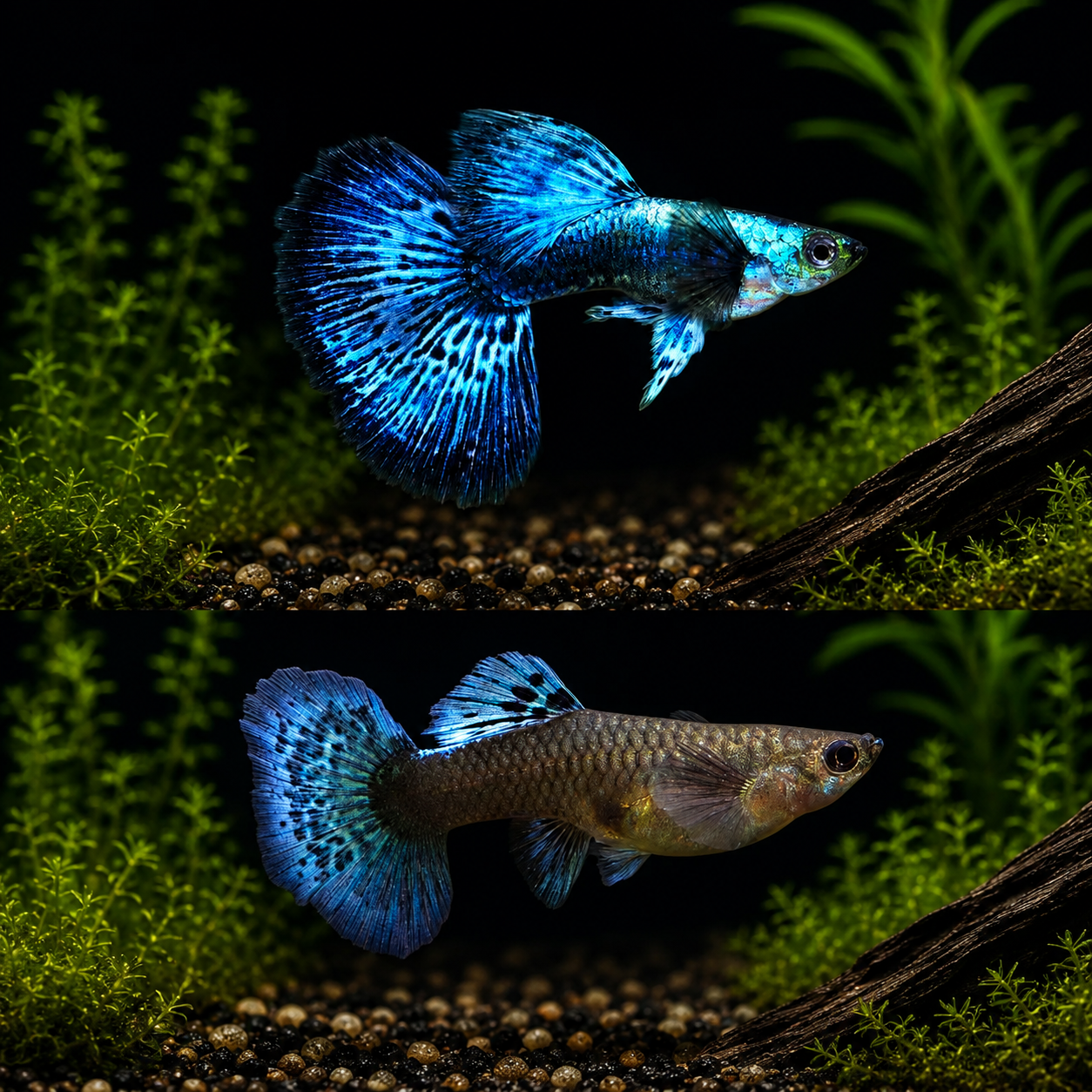
Here is the English version of the technical data sheet for the Guppy (Poecilia reticulata), structured for commercial aquaculture and breeding management.
1. Classification & General Description
Parameter | Specification |
Scientific Name | Poecilia reticulata (Peters, 1859) |
Common Name | Guppy, Millionfish, Rainbow fish |
Family | Poeciliidae |
Origin | Northern South America (Venezuela, Trinidad & Tobago, Guyana, northern Brazil). Globally established in commercial aquaculture. |
Sexual Dimorphism | Males: Smaller (3–4 cm), highly intense coloration, developed finnage, and presence of a gonopodium (modified anal fin used as an intromittent organ). Females: Larger (5–6 cm), duller/greyish body coloration, robust abdomen, and a visible gravid spot near the anal fin. |
2. Optimal Water Quality Parameters
Guppies are highly adaptable, but commercial production or maintaining pure strains requires strict control over the following ranges:
Temperature: 22°C – 28°C / 72°F – 82°F (Optimal breeding range: 24°C – 26°C / 75°F – 79°F).
pH: 7.0 – 8.2 (Slightly alkaline preference).
General Hardness (GH): 10 – 25° dGH (Moderately hard to hard water; low calcium and magnesium levels lead to poor fin development and skeletal deformities).
Carbonate Hardness (KH): 5 – 10° dKH.
Nitrogenous Compounds:
Ammonia ($NH_3$ / $NH_4^+$): 0 mg/L
Nitrite ($NO_2^-$): 0 mg/L
Nitrate ($NO_3^-$): < 20 mg/L
3. Nutritional Management
Guppies are omnivorous with a high metabolic rate, particularly during the fry stage.
Fry Stage: Requires a minimum of 45–50% crude protein during the first few weeks. Live feed such as Artemia nauplii (brine shrimp), microworms, or high-protein micronized starters (100–200 microns particle size).
Juveniles & Adults: Commercial balanced diet (crumbled pellets or high-grade flakes) with 35–40% crude protein. Supplementation with plant matter (Spirulina, kelp) is highly recommended to support intestinal health and enhance natural pigmentation.
Feeding Frequency: 2 to 4 times daily in small rations that can be fully consumed under 2 minutes to minimize ammonia spikes in the system.
4. Breeding & Life Cycle
Reproductive Strategy: Ovoviviparous (internal fertilization; females give birth to fully formed, free-swimming live fry).
Sexual Maturity: 2 to 3 months of age.
Gestation Period: 21 to 30 days (highly dependent on water temperature).
Fecundity: Ranges from 20 to over 100 fry per brood, correlating with the female's size, age, and nutritional status.
Fry Management: Requires breeding traps, dense floating vegetation (Salvinia, Azolla, Red Root Floaters), or immediate removal of the female post-parturition to mitigate cannibalism.